
Alternatives to Health Insurance in 2027: What Each One Costs and Who It’s For
Nov 9, 2026 · 10 mins
On this page
The short answer
If you’re healthy, traditional insurance asks a lot. You pay every month for coverage you rarely use—plus all those out of pocket costs your insurance doesn’t cover. And insurers are asking for another 15% in 2027.
For healthy adults, ionava is a powerful alternative. From $100/month, you get a Wallet for everyday health spending and a Vault of reserved cash ($300k, $700k or $1M) to use for Major health events. Other options include self-funding, direct primary care, health sharing ministries and CrowdHealth. If you have an ongoing condition, a leaner ACA plan is still the safer pick.
Got 5 mins? Take our Health Score to get your custom pricing without commitment.
Alternatives to health insurance at a glance
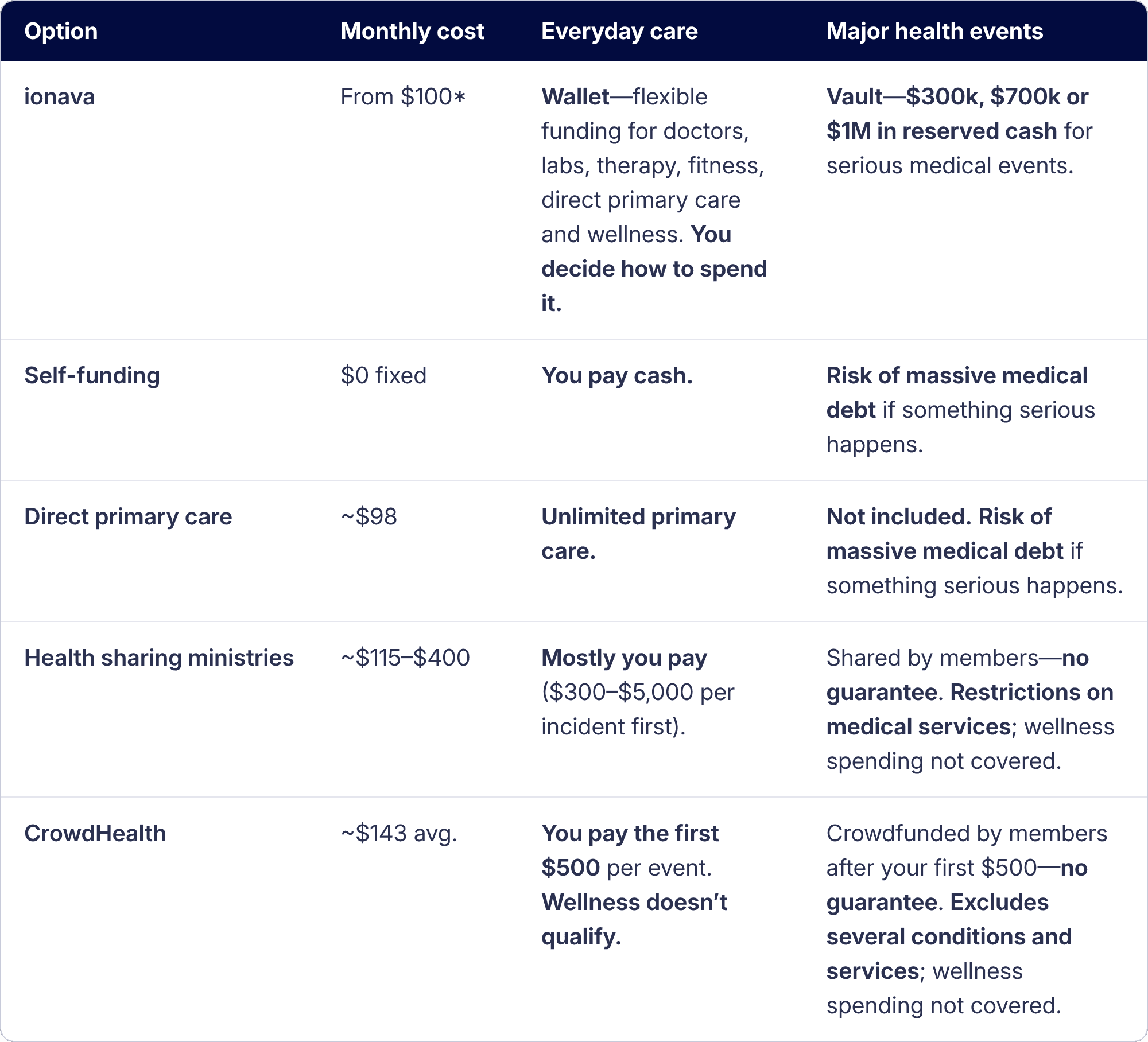
*It depends on your Health Score. See your custom pricing here.
With ionava, self-funding and CrowdHealth, there are no networks or prior authorizations. This means you get to choose what doctor and what care you want.
Prices as of November 2026. Full details and sources in each section below.
How we compared them
We compared each option on monthly cost, how to pay for a Major medical event, health conditions, and who qualifies. Prices come from each provider’s own pages and public sources like KFF and CMS and where an option isn’t right for you, ours included, we say so.
ionava
ionava is a financial platform offering a powerful alternative to health insurance—built on the idea that people should be rewarded for investing in their health. ionava is not insurance. It’s a different model entirely.
How it works
- Get your Health Score. It looks at factors like age and health and sets your price.
- Choose your Vault. Reserved cash of $300k, $700k or $1M for health’s 'Big What-Ifs'.
- Use your Wallet. A debit card you can use to pay for doctors, labs, therapy, fitness, preventive care, wellness goods/services, and direct primary care at transparent cash prices. You get to decide how to spend your money.
You earn interest on your unused Wallet money. This means whatever money you don’t spend in your Wallet grows at 2% or even higher, depending on your healthy behaviors.
What it costs: From $100/month, based on your Health Score. One subscription price, set for life—it never increases as long as you’re a member. ionava is 50% cheaper than traditional health insurance.
Major health events: Your Vault unlocks during a defined Major health event—a chronic, critical or terminal illness. It has a 6-month Vesting period that starts the day you join.
Who qualifies: People aged 21–55 in the top 20% of Health Scores. We’re expanding eligibility as the company grows.
No gatekeepers: ionava doesn’t rely on networks, prior authorizations, or third-party decision-makers. It never approves or denies care. You choose where you go.
Best for: Healthy adults who rarely use insurance but want to be financially prepared for serious health events.
Skip it if: You have an ongoing serious condition or expect large medical costs soon.
Self-funding (paying cash)
Self-funding means skipping insurance and paying for care yourself, as you go. Ask for cash prices up front (they’re often far lower than what gets billed through insurance) and negotiate big bills.
What it costs: $0 fixed. You pay only for what you use.
Major health events: It’s yours. A serious diagnosis can run into the high six figures.
Health conditions: No one can turn you down, but ongoing conditions mean ongoing bills.
Best for: People with savings large enough to absorb a serious illness.
The catch: If you get seriously ill, you have a risk of becoming bankrupt by medical debt.
Direct primary care (DPC)
Direct primary care is a membership with a primary care practice: a flat monthly fee for visits, basic labs and messaging your doctor. No copays, no billing codes.
What it costs: Around $98/month on average.
Major health events: DPC doesn’t help—hospital stays, surgery and specialists aren’t part of it.
Health conditions: Most practices accept everyone.
Best for: Anyone who wants access to a doctor without waiting times or insurance hassle.
The catch: Primary care only. Prescriptions and outside labs often cost extra. Still doesn’t provide any protection for the big health ‘What-Ifs’.
Pairs well with: ionava—pay your membership from your Wallet and keep your Vault for the 'Big What-Ifs'.
Community-funded options: health sharing ministries and CrowdHealth
Both are built on the same idea—members help pay each other’s medical bills. Neither is insurance, and neither guarantees a bill gets paid. But they work differently.
Health care sharing ministries
Members pay a monthly share into a common pool, and the pool shares eligible medical costs. Medi-Share, Samaritan Ministries and Christian Healthcare Ministries are the best known. Zion HealthShare and Sedera offer versions without a faith requirement.
What it costs: About $115–$400/month for an individual. You pay the first $300–$5,000 of each incident yourself, depending on the plan.
Major health events: Members share it—if it’s eligible under the ministry’s guidelines. There’s no legal obligation to pay, and no guarantee the community will come through for all the bills.
Health conditions: Usually limited. Medi-Share, for example, doesn’t share pre-existing conditions for the first 36 months.
Best for: People of faith who value community and accept the lack of a guarantee.
The catch: Most require a Christian statement of faith and lifestyle commitments. And if a ministry runs short, there’s no state fund to back it up.
CrowdHealth
CrowdHealth is secular and works more like crowdfunding than a shared pool. When a member has a bill, other members fund it directly.
What it costs: A $60–$65/month membership fee plus a monthly contribution to other members’ bills—capped at $140 if you’re under 55. The average is about $143/month for members under 55.
Major health events: You pay the first $500 of each health event. The crowd funds the rest, and CrowdHealth negotiates the bill down first.
Health conditions: Not funded in years 1–2. From year 3, up to $25k a year.
Best for: Healthy people who want a low monthly price and no faith requirement.
The catch: No guarantee. And it doesn't cover wellness spending, so if you're a health-oriented person, you still won't get any ROI for investing in your health.
Skip both if: You have a condition that needs care now, or you need certainty that a large bill will be paid.
Other options you’ll see
These come up in almost every search. They’re narrower tools—useful for specific gaps, rarely a full plan on their own.
Discount cards. A monthly fee for reduced prices at participating providers. They’re not insurance and pay nothing toward your bills. Read the fine print—the FTC has warned about cards that overpromise.
Indemnity plans. Pay you a fixed amount per service—say, a set sum per doctor visit or hospital day—no matter what the care costs. Helpful as an add-on. Not meant to be your only protection.
Replacing insurance vs. using something alongside it
Ready to replace your insurance? The most common setup is ionava + direct primary care: your own doctor on a flat fee, paid from your Wallet, plus reserved cash for the 'Big What-Ifs'.
Keeping your plan? Many people keep ionava alongside their insurance—downgrading their ACA plan to something catastrophic, and using the Wallet for the wellness spending their ACA plan won’t touch.
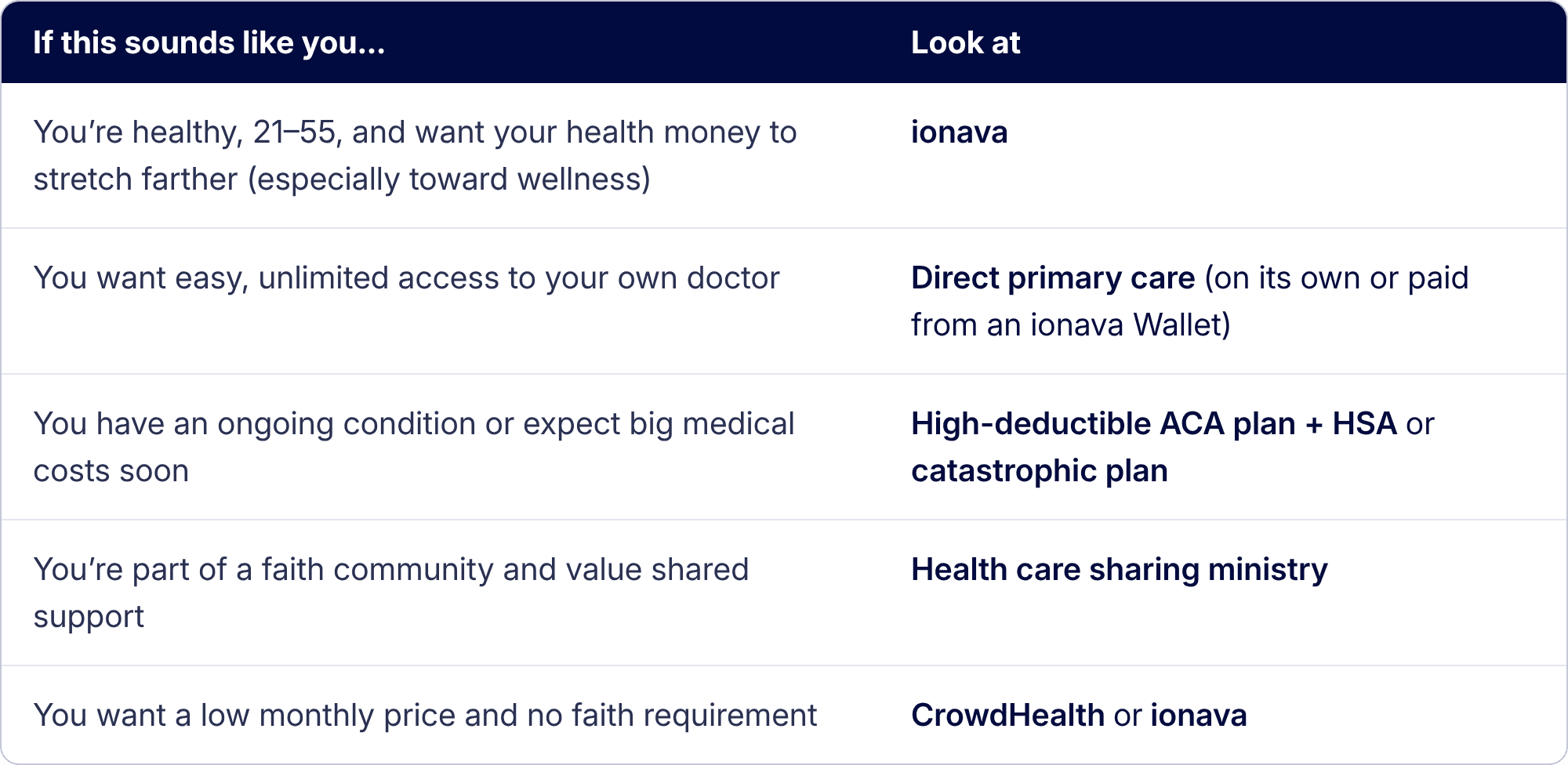
Which alternative fits you?
The bottom line
Traditional insurance asks you to pay every month for coverage you hope you’ll never use.
The alternatives ask a different question: what do you actually need?
If you have a condition to manage, an ACA plan is still your safest bet. If you’re healthy and want your money to work for you (not disappear into premiums) there’s a better way.
This is not health insurance. This is better.
See where you stand. Get your Health Score.
----------------------------------------------
Sources CrowdHealth: How it works WhichHealthShare: CrowdHealth vs. health sharing WhichHealthShare: 2026 health sharing costs DPC America: Direct primary care and HSAs in 2026 KFF: How much and why ACA Marketplace premiums are going up in 2027